Get-well flowers for hospitals in Thailand
Most Thai hospitals do not publish a flower policy. This guide explains what to ask, which wards may say no, and how to reach the international patient team before you order.
Updated November 2, 2026
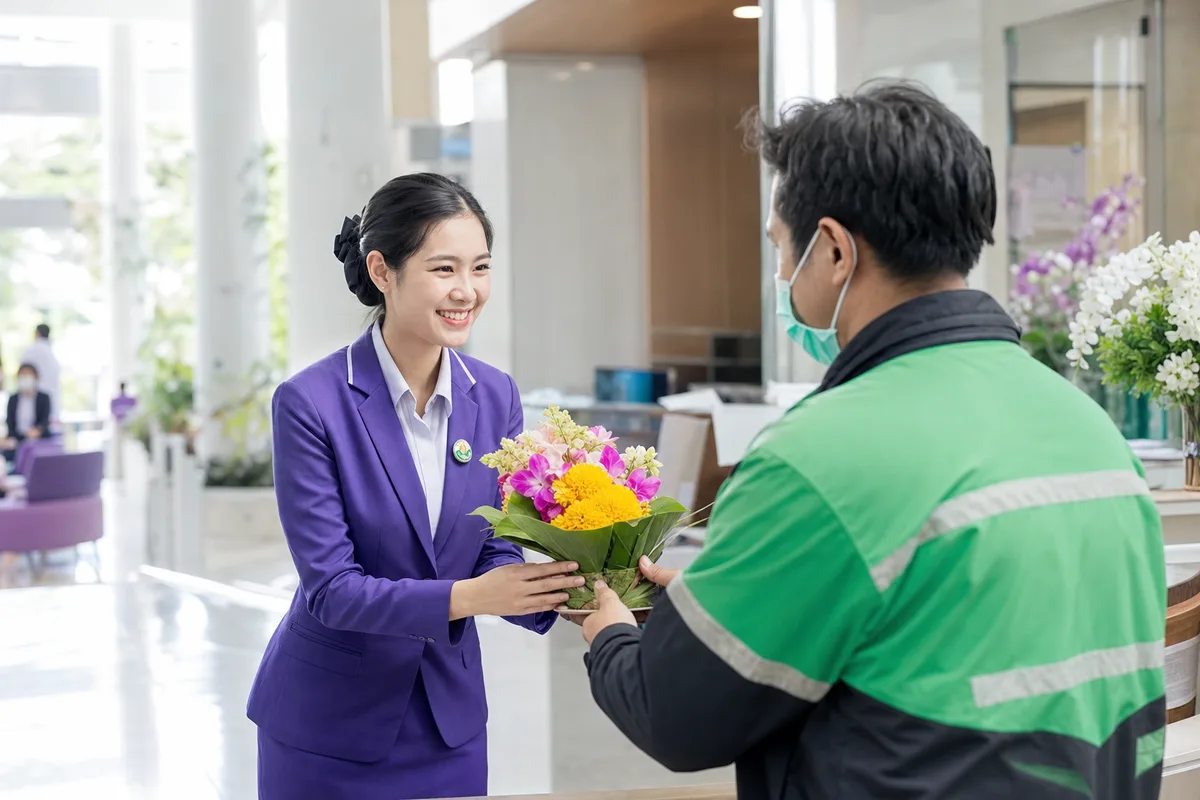
The honest starting point: most hospitals say nothing
We checked the websites of many hospitals that serve foreigners in Bangkok, Phuket, Pattaya, Chiang Mai, Hua Hin and Samui. Almost none publish a flower policy. They list visiting hours at best, and sometimes not even that. So "are flowers allowed?" does not have a lookup answer. You have to ask, and this guide shows what to ask and whom.
That is not a reason to give up. It is a reason to do thirty seconds of checking before you pay for an arrangement that may be turned away at the door.
Four questions to put to the ward
- Are fresh flowers allowed on this ward? Some wards accept them, some limit them, and some ask for none.
- Is the patient in a restricted unit? Intensive care is the one to ask about first. Hospitals often restrict flowers, plants and balloons where infection control or allergies are a concern.
- Where does a delivery go? Possible answers: the nurse station, the reception counter of the building, the patient room, or the family. A courier cannot always walk onto a ward.
- What does the courier need? The patient's name as registered, the room or bed number, and a contact who answers a phone.
Ask the patient's family if you can. They are standing in the ward and can ask a nurse directly. Our FAQ covers other delivery questions.
What the hospitals that do publish say
A few facts are on public pages.
- Bangkok Hospital Pattaya runs an in-ward service for inpatients. Its page lists flower ordering with baskets, bouquets and vases, in fresh and dried flowers, delivered to the patient's room with your message on a card. Orders go through its concierge or customer service lines, and the page gives service hours of 8 a.m. to 6 p.m. The concierge number is 0 3825 9989. The page does not say whether outside florists may deliver directly, so ask before booking one.
- Bangkok Hospital Phuket lists a concierge service that can arrange flower delivery and get-well gifts.
- Bangkok Hospital Siriroj in Phuket publishes advice on its ICU pages: flowers and balloons are not always welcome. The page mentions allergies to plants or latex, and it says to ask a doctor what is appropriate.
- Bumrungrad International Hospital in Bangkok states recommended visiting hours of 6 a.m. to 10 p.m., with visitors allowed at any time for patients in single rooms. We found no flower rule on its pages. It has a medical coordination office for international patients, reached through the main line, +66 2066 8888. Hospitals change visiting notices, so check the current one.
For other hospitals in our hospital directory, we did not find a published flower rule. Do not assume permission or refusal from the lack of one.
Who to call: the international patient team
The large private hospitals that treat foreigners have international patient or medical coordination departments, often reached through the main switchboard. They speak English and handle insurance, interpreting and visitor questions. If you do not know the family, this is the best number to ring. Give them:
- The patient's full name as spelled on the registration.
- Your relationship, and whether the family has asked you to get in touch.
- That you want to send flowers, and the date you hope to deliver.
Expect staff to protect patient privacy. They may not confirm that a person is admitted. If so, ask the family to call them, or ask the family for the room number.
What to put on the order
When you brief the florist, write the details in order: patient name, hospital, building and floor, ward or room, a phone number for a contact who can receive the gift, and what to do if the flowers are refused (hand them to the family, or take them to a named person). Our guide to sending flowers to Thailand from abroad explains how the ordering works.
Choosing the arrangement
Hospital rooms are small, and relatives are often camped in them. Choose a compact arrangement in a stable container, and ask for little or no scent, since patients may be sensitive to it. Skip balloons unless the hospital offers them. Avoid anything that reads as a funeral piece, which our funeral flowers guide describes.
If the patient cannot have flowers, consider a card sent to the family. Our card guide includes wording for get-well notes that avoid assumptions about the illness.
When the answer is no
If the ward says no flowers, the trip is not wasted. Ask whether the family would like the arrangement delivered to their home or to a room outside the ward. Many families are glad of something cheerful at home after a long day at the bedside. You can also send the card by itself to the family, which keeps the message and avoids the problem.
Common questions
Do Thai hospitals allow flowers?
It depends on the hospital and the ward. Most do not publish a rule, so you ask. Some hospitals run their own in-ward flower service.
Can I send flowers to an intensive care unit?
Assume no until the hospital says otherwise. One hospital's ICU guidance says flowers and balloons are not always welcome and advises asking a doctor what is appropriate.
What does the florist need to deliver to a ward?
The patient's full name as registered, the hospital and building, the ward or room if known, and a phone number for a contact who can receive the flowers. See our hospital directory.
What if the patient has already been discharged?
Confirm the status on the day. Ask the family to message you before the florist is booked.
Ready to send?
A local florist arranges the bouquet and delivers it to the address you give.
See bouquets