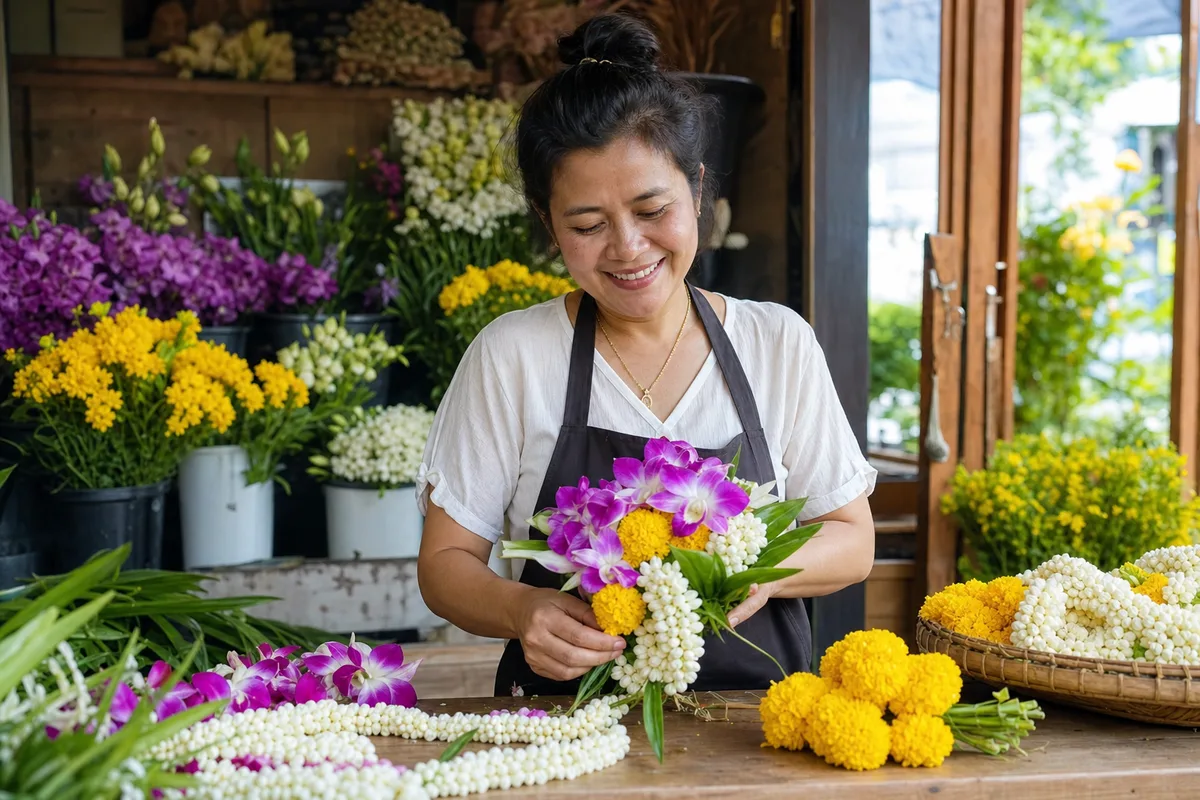
What to write on the card when you send flowers to Thailand
A card is short, and it travels through a lobby, a florist and a stranger's hands. Here are plain English lines that translate well and a few Thai phrases with pronunciation.
Updated November 2, 2026
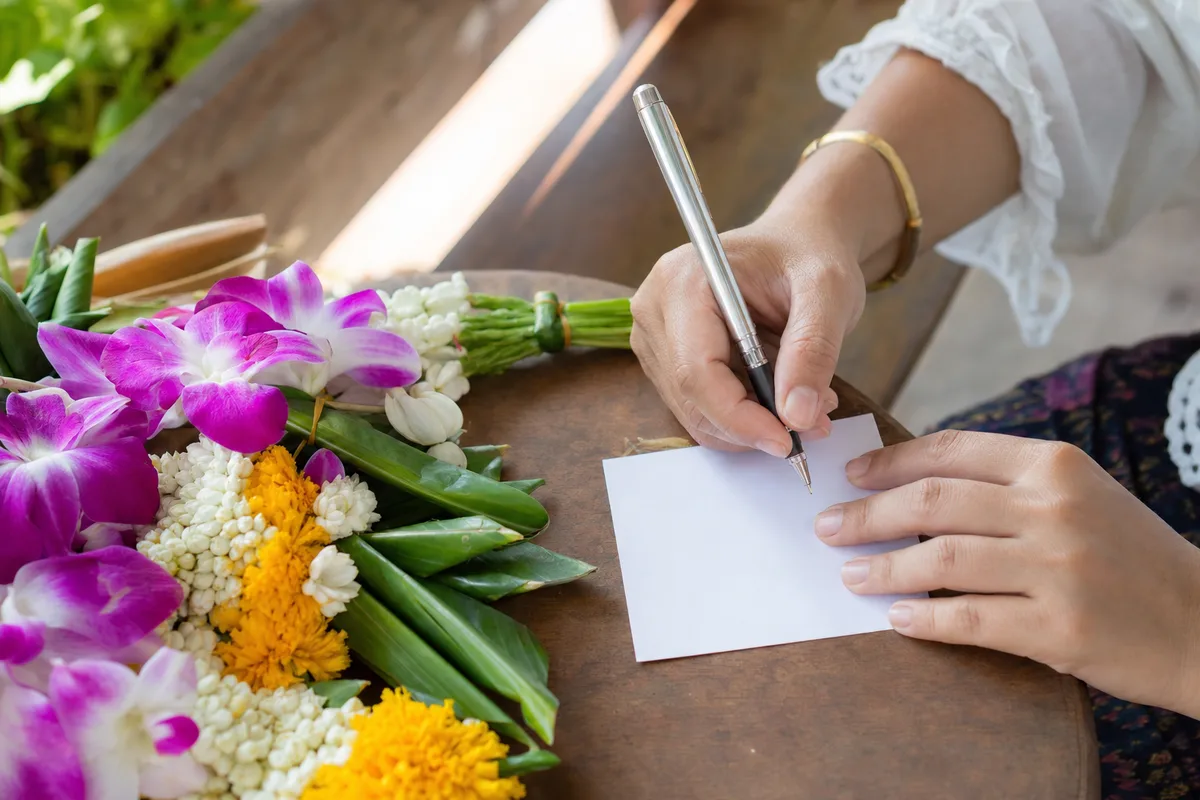
The card has more readers than you think
A card sent to Thailand from abroad is read by the florist, sometimes by a desk clerk, and then by the person you care about. It may also be copied by hand from an order form. That affects how you write it. Short, warm and plain wins over clever.
You do not need to write in Thai. A message in clear English is better than a Thai message with an error in it. If you want to add a touch of the language, use a phrase from this page and ask a Thai friend to confirm it. A friend of the recipient is ideal, because they will also know how the person likes to be addressed.
A simple formula
- The name of the recipient, as they like to be called.
- One sentence that says why you are sending the flowers.
- One sentence that says what you wish them.
- Your name, in full, with a relationship if it helps.
Example: Dear Nok, congratulations on the new job. Wishing you every success. With love, your sister Emma. That is twenty words, and no one will mind reading it.
English lines that translate well
Birthday
- Happy birthday, Nong. Thinking of you today.
- Wishing you a year of good health and good news.
Thank you
- Thank you for looking after us last week.
- With many thanks and warm regards.
Congratulations
- Congratulations on your graduation. We are proud of you. See the graduation guide for flower ideas.
Get well
- Get well soon. We are thinking of you. See the get well and hospital guide.
Sympathy
- With deepest sympathy. Our thoughts are with you and your family.
Avoid idioms. Sayings that depend on English humour, sports or weather may not carry over. A sentence like You deserve every bit of this reads clearly to a reader whose English is a second language, and a joke often does not.
Thai phrases you can use
Thai has no single official Latin spelling, so the pronunciation guides below are approximate. Tones are not shown. The phrases come from standard phrasebooks. If you use one on a card, ask a Thai speaker to confirm that it suits the person.
| Meaning | Thai | Pronunciation |
|---|---|---|
| Hello | สวัสดี | sa-wat-dee |
| Thank you | ขอบคุณ | khop khun |
| Happy birthday | สุขสันต์วันเกิด | suk san wan koet |
| Congratulations | ยินดีด้วย | yin dee duay |
| Get well soon | หายเร็วๆ นะ | haai reo reo na |
| My condolences | ขอแสดงความเสียใจ | khor sa-daeng khwam sia jai |
A note on tone. The get well phrase ends with นะ (na), which sounds friendly and informal. It is good for a friend or a colleague of your age. For an elder or a teacher, a Thai friend may suggest a more formal wording, so ask. The congratulations phrase is described by one language site as somewhat official, while a more casual one exists, which is another reason to check the register.
Which phrase for which flower
If you are matching a card to flowers, think of the meaning first. Marigold, the flower described as glowing like a star, goes well with congratulations. Jasmine suits a card to a mother. Orchids, linked to friendship and support, pair naturally with a thank you. The etiquette guide lists each. Avoid mixing a cheerful card with a flower that has funeral associations.
Cards for specific people
The right words depend on who is reading. A few patterns help.
- A parent or grandparent. Warm and simple. Thank you for everything. I am thinking of you today and I love you. For a mother, the jasmine tradition makes a card on Mother's Day, 12 August, especially welcome. The Mother's Day guide has ideas.
- A teacher, a boss or an elder. Slightly more formal. With sincere thanks for your guidance and kindness. Skip nicknames and keep the sentence whole.
- A host or a hotel contact. Say what they did. Thank you for the welcome and for the help with our trip. A specific line is remembered long after a general one.
- A friend. Your own voice is fine. Keep slang out, since the writer copying it may not know it.
- A group. List the names in full, or write the group name and add one line. A card from all of us at the Stockholm office is clear and kind.
Where the card goes with a gift to a business, put the company name in the order notes as well as on the card. The person at the desk reads the notes first and the card never.
Practical details
- Print the recipient's name in the same spelling as on the order.
- Do not use abbreviations or emoji. Some florists write the card by hand and cannot copy them.
- If you add Thai script, paste it from this page. Do not retype it, because a missing vowel mark changes the word.
- Put the Thai line on its own row so that the writer copies it as a unit.
- Check the order summary. Ask the florist to read the card text back to you if they can.
For the rest of the order, such as address and phone number, see the guide to sending flowers from abroad.
Common questions
Should I write the card in Thai?
English is fine for most recipients, and a card in clear English is better than Thai you are unsure of. If you add Thai, keep it to a phrase and ask a Thai friend of the recipient to check it. Thai has no single official way to write its sounds in Latin letters, so spellings of the pronunciation differ between sources.
How long should the message be?
A line or two. Cards are often small, and the person who writes them out for you may be copying from an order form. Short sentences reduce the chance of a typo in a language the writer may not read easily.
Should I sign with my full name?
Yes, especially if you are sending a gift to a person who knows you by a nickname or to an office. Add your relationship if it helps, for example your friend Anna from Berlin.
What if I am sending to a family in mourning?
Use the single condolence phrase below or a short English line, and read the funeral flowers guide. Do not use jokes, bright wording or exclamation marks.
Ready to send?
A local florist arranges the bouquet and delivers it to the address you give.
See bouquets